99% of People Get This Simple Math Problem Wrong: Discover Why the Answer Is NOT 16!
99% of People Get This Simple Math Problem Wrong: Discover Why the Answer Is NOT 16!
Introduction
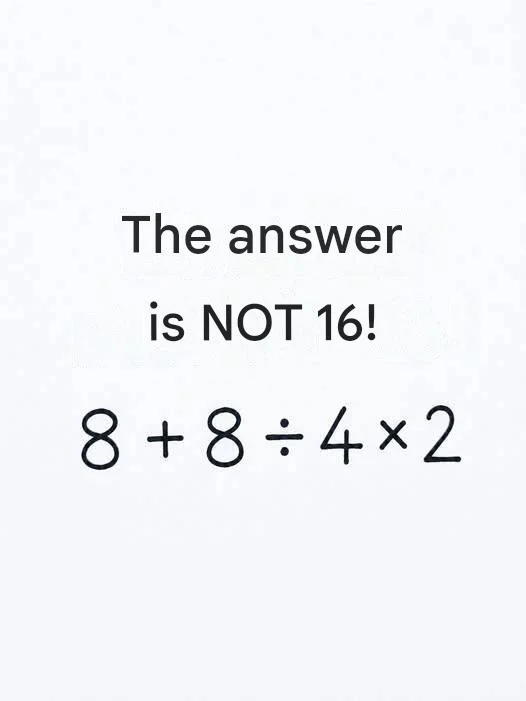
Viral math puzzles often spark heated comment-section debates over basic arithmetic rules. In this image, the expression $8 + 8 \div 4 \times 2$ sits under a bold warning that “The answer is NOT 16!”. Read on to learn how the standard order of operations resolves the confusion, why 16 is a common trap, and how to get the exact answer every time.
Step 1 — Handle Division and Multiplication From Left to Right
-
What to do: Ignore the addition at the start for a moment and focus on the division and multiplication in the middle and end of $8 + 8 \div 4 \times 2$.
-
How to do it: Under PEMDAS/BODMAS rules, division and multiplication share the same priority level, so you evaluate them strictly from left to right: first compute $8 \div 4 = 2$, and then multiply $2 \times 2 = 4$.
-
Explanation: Treating division and multiplication as a left-to-right pair keeps the expression clear and prevents accidental grouping errors.
Step 2 — Complete the Addition at the End
-
What to do: Bring back the leading $8 +$ and combine it with the result from Step 1.
-
How to do it: Add $8 + 4$ to get the final answer of 12.
-
Common mistake to avoid: Do not solve strictly from left to right starting with $8 + 8 = 16$, then $16 \div 4 = 4$, and $4 \times 2 = 8$—and do not multiply $4 \times 2 = 8$ first, divide $8 \div 8 = 1$, or misread the signs to land on 16.
Step 3 — Verify Every Step Against Order of Operations
-
What to do: Rewrite the expression with parentheses around the higher-priority operations to double-check your work.
-
How to do it: Write $8 + ((8 \div 4) \times 2) = 8 + (2 \times 2) = 8 + 4 = 12$.
-
Explanation: Adding mental parentheses makes the structure unmistakable and confirms why 12 is the only mathematically consistent answer.
Tips for Better Results
-
Tip 1: Keep it simple — Always scan an expression for multiplication and division before touching addition or subtraction.
-
Tip 2: Choose to work left to right whenever two operations sit at the exact same priority tier (like $\div$ and $\times$, or $+$ and $-$).
-
Tip 3: Avoid letting bold captions like “The answer is NOT 16!” rush you into guessing without writing down the middle steps.
-
Tip 4: Try inserting invisible parentheses around multiplication and division terms so your eyes do not merge numbers prematurely.
-
Tip 5: For a better result when discussing viral math posts, write out each intermediate line rather than just dropping a single number.
-
Tip 6: Check each symbol carefully so you do not mistake a $\div$ sign for a $+$ or $-$ sign.