Think You’re Good at Mental Arithmetic? This Simple Test Tricks Almost Everyone!
Think You’re Good at Mental Arithmetic? This Simple Test Tricks Almost Everyone!
Introduction
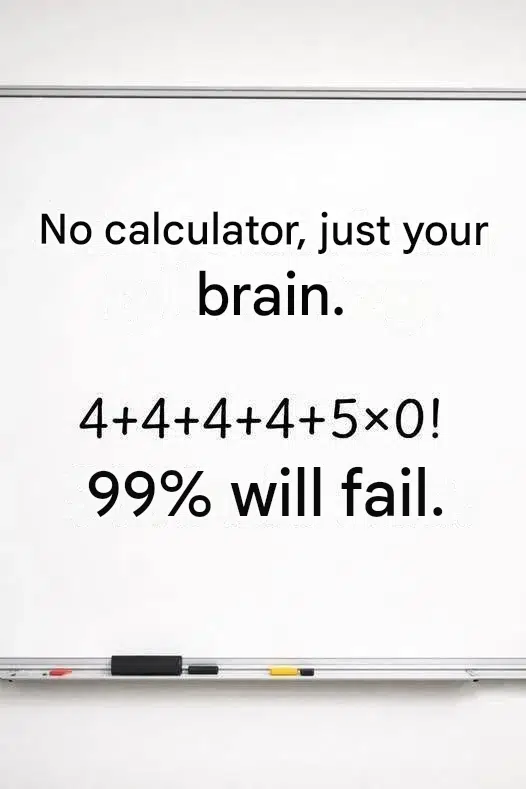
The puzzle 4 + 4 + 4 + 4 + 5 × 0! claims that 99% of people fail, and the reason is a single habit: calculating from left to right. Once you know the rule that every calculator follows, it takes seconds. This guide shows you how to solve it, why people slip up, and how to avoid the trap in similar puzzles.
Step 1: Spot the Multiplication
What to do: Scan the expression for operations that come first.
How to do it: Look past the string of fours and find the multiplication at the end: 5 × 0. Under the order of operations (PEMDAS or BODMAS), multiplication and division are done before addition and subtraction.
Common mistake to avoid: Starting at the left and adding in the order you read. That treats the whole sum as if it were in brackets.
Step 2: Solve the Multiplication, Then Add
What to do: Replace the product with its value and finish.
How to do it: 5 × 0 = 0, so the expression becomes 4 + 4 + 4 + 4 + 0. Add them: 4 + 4 = 8, 8 + 4 = 12, 12 + 4 = 16, and 16 + 0 = 16.
Common mistake to avoid: Adding 4 + 4 + 4 + 4 + 5 = 21 and then multiplying by 0 for a final answer of 0. The multiplication applies only to the 5.
Step 3: Check the Exclamation Mark
What to do: Make sure you’ve read the symbol correctly.
How to do it: Here the “!” is punctuation for emphasis, the same as the exclamation marks in the headline. In math, a “!” after a number means factorial, and 0! equals 1. If a puzzle meant that, the answer would be 21. When the context is casual wording, treat it as an exclamation. If you’re unsure, say both readings.
Tips for Better Results
- Tip 1: Look for multiplication and division first.
- Tip 2: Imagine brackets around 5 × 0.
- Tip 3: Remember that anything times 0 is 0.
- Tip 4: Write each step on its own line.
- Tip 5: Check with a calculator afterward.
- Tip 6: Watch for punctuation that could change the meaning.
- Tip 7: Don’t trust “99% will fail” claims.
- Tip 8: Practice with similar puzzles to build the habit.